

Strategic synergies between academia and industry
Skåne and the Malmö/Lund area are well-connected to Europe and the rest of the world and are consistently ranked among the most innovative regions globally. At the centre is Lund, where top-level research, high tech companies and innovation environments are accessible within a 15-minute bicycle ride. Lund is closely linked to Malmö, Sweden’s third-largest city, and to Copenhagen via the Öresund Bridge. Other major Swedish innovation hubs can be reached within a few hours.
The actors in the region have contributed important inventions to society including Bluetooth, the artificial kidney and advanced digital camera systems. Proximity between universities, research centres and companies, combined with strong support from incubators, makes Skåne attractive for entrepreneurs and start-ups in advanced technologies and semiconductors. The region is also home to global companies such as Alfa Laval, Axis Communications, Ericsson, Sony, Saab and Tetra Pak.
The deep tech community in Skåne
Lund University is one of Europe’s leading institutions, with advanced facilities for developing and testing new materials and technologies. Research in semiconductors and related fields builds on long-standing collaboration between academia and industry. For example, Ericsson has played a key role in developing wireless communication technologies. This has helped create a strong ecosystem for connected systems, including 5G and future 6G technologies, and the talented workforce is attracting companies such as Bosch, Sony and Volvo Cars.
Skåne also has a strong start-up community developing technologies such as radar, sensors, cameras, medical diagnostics, signal processing and AI. These technologies are used in industries like transport, healthcare, defence and communications and are often developed locally and then integrated into products by companies in the region.
Future growth and collaboration in semiconductor research and development
Skåne and the Lund/Malmö area are advancing several key areas in semiconductor research:
- Power electronics help reduce energy consumption in applications like electric vehicles and renewable energy systems.
- New materials for AI-inspired computing, enabling faster and more energy-efficient data processing.
- Integration of different materials and chip components to improve performance and reduce costs.
- New types of transistors that can outperform today’s standard technology (CMOS) in emerging applications such as quantum technology and neuromorphic computing.
- System design developed in collaboration with partners such as Chalmers University of Technology.
Research is supported by world-leading advanced laboratories that allow scientists and engineers to design and test materials at the atomic level and explore how they can be used in next-generation electronics. The actors in the region also supports start-ups in scaling their technologies from lab to production, including companies such as: Acconeer, AlignedBio, AlixLabs, BeammWave, Hexagem, NordAmps and Xenergic.
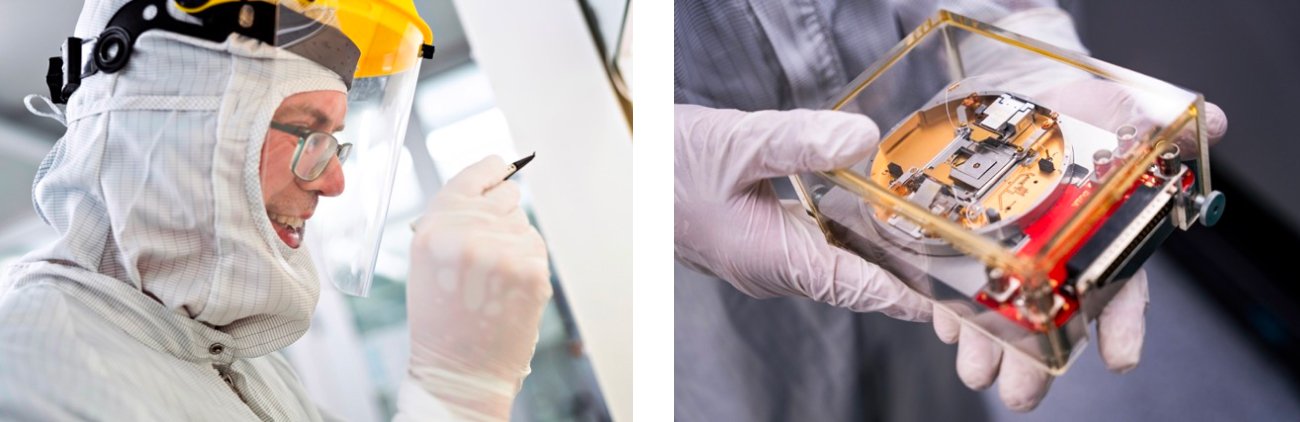
Right: To develop more efficient technologies such as solar cells and other electronic devices, researchers use this special sample holder in a Scanning Electron Microscope. It enables Electron Beam Induced Current (EBIC) characterisation and current–voltage (I‑V) measurements, providing insights that help improve device design and performance. Image: Johan Persson, NanoLund at Lund University.
Lund University, along with Chalmers, Linköping University and KTH Royal Institute of Technology, also hosts Sweden’s Pilot Line for advanced semiconductor materials, through the EU Chips Joint Undertaking – Chips JU (Wide Band Gap Pilot Line, WBG PL). The focus in Lund is on materials such as gallium nitride, gallium oxide and aluminium nitride which enable smaller, faster and more energy-efficient electronic devices – contributing to more sustainable technologies overall.
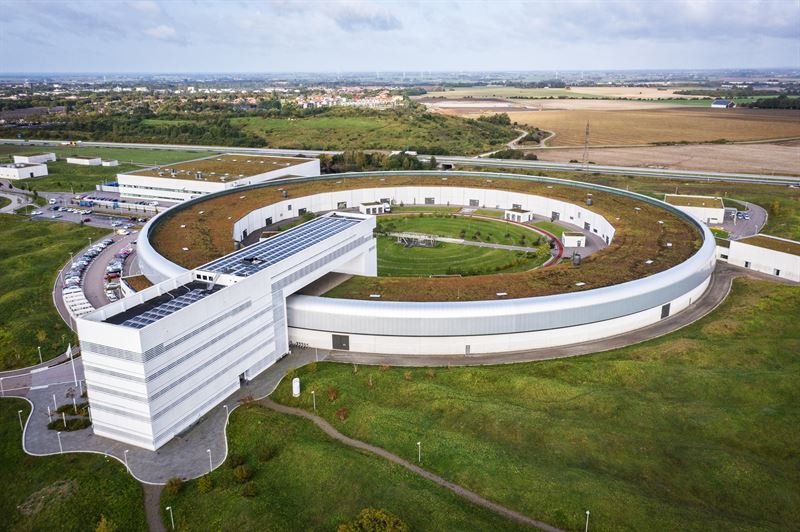
Academia, industry and the public sector work closely together and collaborate with partners across Europe through initiatives such as Silicon Europe and the European Semiconductor Regions Alliance. At the regional level, stakeholders are aligned through Skåne’s Research and Innovation Council (Swedish: Forsknings- och innovationsrådet I Skåne = FIRS) and smart specialization strategy, where semiconductors play a key role.
Get in touch with us
Want to learn more about the semiconductor ecosystem in Southern Sweden – and how Skåne’s companies and researchers are connected across Sweden, Europe, and beyond? Reach out to Krisztina Anderberg Halasz at Region Skåne, or explore Invest in Skåne.