

Sweden’s semiconductor
strategy 2035
Sweden’s national semiconductor strategy 2035, developed by Semiconductor Sweden, Svensk Elektronik, RISE, FMV, Smartare Elektroniksystem and Photonic Sweden, is the result of deep industry anchoring. Months of roundtables, in-depth interviews and survey results across the ecosystem have led to clear recommendations to ensure that Sweden leverages it strenghts to supports its innovators, scaleups and brings its full potential to the semiconductor value chain.
This page links to the strategy document and summary. Further it contains a high level summary of key takeaways and proposals.
Read the strategy

Sweden's national semiconductor strategy 2035
Data, analysis, action programme, SWOT and international comparison
Det osynliga guldet: Sveriges strategi för halvledare 2035
“The invisible gold: Sweden’s strategy for semiconductors 2035” Recommendations and strategic direction for decision-makers and industry.
The strategy was launched at Semiconductor 2026, Gothenburg, in April 2026.
Why does Sweden need a national strategy for semiconductors?
Semiconductors are an invisible part of the foundation of the Swedish economy. Yet the semiconductor shortage of skills is today one of the greatest barriers to growth, both in Sweden and globally. The global market is set to more than double, from $775 billion in 2024 to $1,600 billion by 2030, driven by AI, electrification, 6G and defence.
Access to semiconductor expertise has become a strategic issue for both industrial competitiveness and national security. Geopolitical concentration, particularly around Taiwan, creates real supply risk for Swedish companies and defence systems. Building sovereign capability, even in selected niches, gives Sweden strategic influence it otherwise lacks.
The semiconductor numbers for Sweden:
Sweden’s leading exporters such as automotive, aerospace, defence technology and telecom master advanced electronics and semiconductor integration – and future innovation depend on having a strong semiconductor ecosystem.
Sweden’s challenge - strong on research but needs to accelerate industrial value creation
Swedish universities lead world-class research in areas including power electronics, photonics and high-frequency radio technology, with labs coordinated through the national Myfab network. But underfunding and ageing equipment risk limiting Sweden’s competitiveness and innovation capability. IVA’s (the Royal Swedish Academy of Engineering Sciences) independent analysis of Sweden’s position in strategic technologies underpins the findings on where scientific capability is strong and where industrial conversion is lagging.
| University | Area of expertise |
|---|---|
| KTH | Silicon carbide (SiC), MEMS, chip design, system architecture |
| Chalmers | RF/microwave, gallium nitride (GaN), photonics, 6G |
| Linköping | Silicon Carbide (SiC) and Gallium Nitride (GaN), organic electronics |
| Lund | Nanoelectronics, photonics, life science, sensors |
| Uppsala | Semiconductor processes, analog design, sensor technology |
Sweden’s strengths in semiconductors
- World-leading system companies: ABB, Ericsson, Saab, Volvo
- World-leading niche companies: Mycronic, Silex, Excillum, Axis
- Strong research: power electronics, photonics, RF, MEMS
- National research infrastructure via Myfab One of Europe's most coherent SiC/GaN value chains
- 5 strong university clusters with specialised expertise
Where Sweden needs to improve
- Fragmented ecosystem, limited national coordination
- Slow government decision-making
- Missing pilot lines for industrialization
- Insufficient risk capital for deep-tech scale-ups
- Skills shortage: chip design, packaging, testing
- Strong knowledge generation, value stays abroad
Sweden’s semiconductor strategy -
Four priority technology areas
The strategy was developed with representatives from the entire value chain: industrial companies, universities, research institutes, startups, investors, defence, and government. Four technology domains where Sweden has genuine strengths and credible paths to global leadership was identified:

Chip & System Architecture

Power Electronics

Photonics

Analog, RF & Mixed Signal
Sweden’s semiconductor strategy -
Supported by six national capabilities
The overview of the Swedish semiconductor strategy and its strategic priorities is building upon four priority technology domains (in yellow). These are in turn supported by six horizontal national capabilities (in blue): system design, advanced packaging and integration, test and validation, industrialisation and scale-up, supply security, and talent.
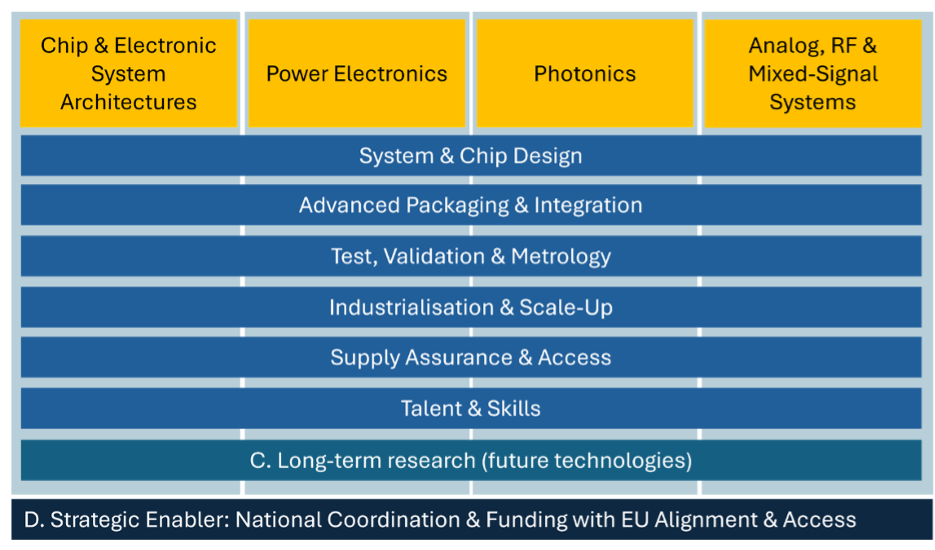
The strategy report describes proposed actions for the core technology areas and national enabling capabilities.
Sweden’s semiconductor strategy -
Recommended action
Without coordinated action, Sweden risks generating advanced knowledge but exporting the industrial value creation.
Sweden’s national semiconductor strategy 2035 recommends a Programme for Advanced Electronics (PAE), a public-private partnership modelled on the successful Programme for Advanced Digitalisation (PAD).
The proposed investment level for Sweden is a public investment of €0.8-1.2bn (approximately SEK 9-13bn) over a horizon of 8-10 years. This is in line with corresponding public investments made in comparable countries such as Finland, Austria, Belgium and the Netherlands.
- The Programme for Advanced Electronics should be funded at the same level as the Programme for Advanced Digitalisation, and Sweden's investment level in semiconductors should be on par with comparable countries.
- Sweden needs to secure long-term funding and talent supply through stronger collaboration between public and private financing, and deeper cooperation between academia and industry.
Let’s build Semiconductor Sweden together
We are here to ensure that Sweden leverages its strengths, supports its innovators and scale-ups, and brings its full potential to the semiconductor value chain. If you’re an innovator or scale-up working in this space, ensure to get in touch and help shape what comes next to join the network.
Additional reading
Semiconductors report by IVA
(Rapport: Halvledare). Published by: the Royal Swedish Academy of Engineering Sciences (IVA), as part of its Swedish Futures programme. Available in: Swedish and English. Analyses Sweden’s position in semiconductor technology and sets out five strategic actions for turning strong research into large scale production.
The Global Chip Race
Application of the Chips Act in Sweden
(Halvledaraktens tillämpning i Sverige, report 0473). Published by: the Swedish Agency for Economic and Regional Growth (Tillväxtverket). Available in: Swedish only. Maps the Swedish semiconductor sector and analyses how Sweden can benefit from the EU Chips Act, including in power electronics, quantum technology and defence technology.