

Industrial leaders with a semicon edge: IRnova
In Kista, Stockholm, a company of 38 people holds a position that few in Europe can match: volume production of the world’s most advanced cooled infrared detectors. IRnova makes high-performance infrared (IR) sensors using III-V semiconductor materials (compound materials that combine elements from groups III and V of the periodic table, valued for their strong optical properties). This is technology difficult to produce, and IRnova is the only manufacturer in Europe with in-house volume production of QWIP (quantum well infrared photodetectors) and T2SL (short for “type-II superlattice”) – quantum structures that make a detector sensitive to very specific infrared wavelengths. IRnova’s sensors are used in defence systems, gas detection equipment, space payloads and drone detection platforms worldwide.
Linda Höglund, R&D manager at IRnova, explains what it takes to build a specialized semiconductor company on a research foundation that goes back 40 years, and why patience and in-house control are IRnova’s real advantages: “From the first research of long wavelength (8-12 µm) QWIP detectors in 1986, it took 13 years to reach volume production of these sensors. When we started developing T2SL in 2004 to cover also the mid wavelength infrared region (3-5 µm), it took another ten years to get the first product to market. For this, you need a very patient investor and a very patient leadership team.” – Linda Höglund, R&D manager, IRnova
From a defence initiative to a European first
IRnova’s origins go back to a strategic decision made by the Swedish state. FMV (the Swedish Defence Materiel Administration) identified infrared sensor technology as an area where Sweden needed to be self-sufficient. Research began at Electrum Laboratory in Kista in 1986, focusing on the QWIP technology, covering the 8 to 12 micrometer long wavelength infrared range, as this part of the wavelength spectrum matters the most in cold conditions and low visibility.
After more than two decades of research and production, the operation was spun off from Acreo (part of RISE, Sweden’s research institute) to become an independent company in 2007, since volume production needs a different kind of organisation. Today IRnova produces thousands of detectors a year, with growing demands to include also space applications. “Our company was founded because Sweden recognised it wanted independence in infrared technology. That need has only grown stronger.” – Linda Höglund, R&D manager, IRnova
Why in-house control is the competitive edge
IRnova competes with larger companies in the US, Israel, and in Europe by controlling its entire development chain in-house, from designing and simulating the quantum structure materials, to cleanroom fabrication, packaging and testing. “We have all the pieces in-house: the advanced quantum structure materials, the simulation tools, the cleanroom access. With all these building blocks, we can control properties at the pixel level, and that’s what makes our sensors competitive.” – Linda Höglund, R&D manager, IRnova
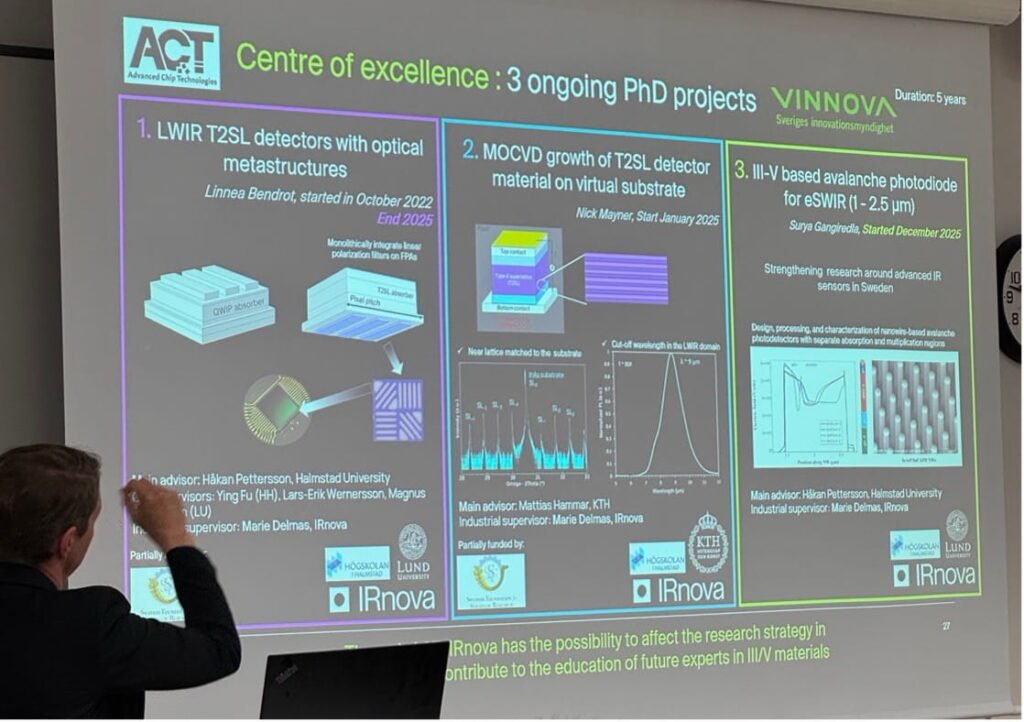
For cleanroom access, IRnova uses Electrum Laboratory in Kista. It’s also connected to MyFab (Sweden’s national infrastructure for micro and nanofabrication), so process steps can be run at partner labs, including Ångström Laboratory in Uppsala and Chalmers in Gothenburg, almost as easily as in-house. University collaboration is key for IRnova’s long-term plans. The company collaborates with KTH (the Royal Institute of Technology in Stockholm), Lund University, Halmstad university and Linköping University and supervises PhD students whose research in simulation and fabrication feeds into product development. Through ACT (Advanced Chip Technologies), a joint effort between industry and universities to build Sweden’s semiconductor skills base, IRnova is currently involved actively in three PhD projects, which further strengthens the bonds to academia.
Where is IRnovas technology heading next?
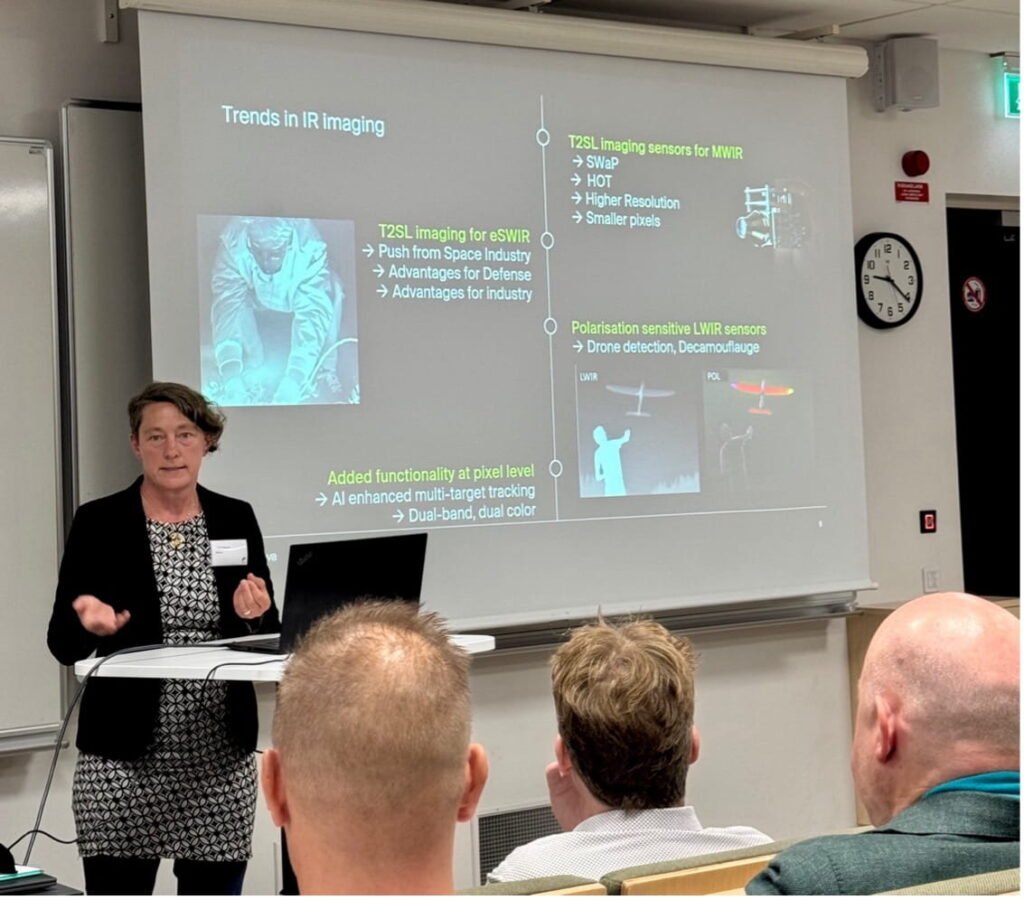
IRnova’s roadmap has a clear direction: smaller pixels for higher resolution and higher operating temperatures to reduce cooling needs. Thanks to megapixel resolution, IRnova’s novel Njord MW (T2SL) and Tyr LW (QWIP) products already deliver sharp, high-dynamic-range midwave and longwave IR imaging where greyscale encodes temperature rather than reflected light. Drone detection, gas analysis, and through-smoke visibility are among the use cases that benefit directly from such image quality and the objective is to further advance along those lines.
Another track on the roadmap is to add more functionality at pixel level. This includes polarimetric sensing (detecting the orientation of light waves, which reveals surface and material details invisible in ordinary images) and dual-colour capability (sensing two infrared wavelength regions at once). Such sensors can extract information which goes beyond the capabilities of any single-band systems, enabling for instance autonomous drone detection and identification of hazardeous gases
With already well-established products for defence and gas imaging, space is IRnova’s next forward-looking area. The company is developing T2SL sensors for the eSWIR band (extended short-wave infrared from 1 to 3µm, a wavelength range useful for satellite imaging) together with Airbus, aiming at a market where affordable volume production is becoming essential as satellite constellations grow. “Space sensors today are extremely expensive. As more satellites need to cooperate, that can’t continue. We want to be part of the large programmes, and that means producing at volume.” – Linda Höglund, R&D manager, IRnova.
Building Sweden’s position in infrared technology
The US has been in the infrared detector market far longer and remains ahead on array sizes and advanced read-out circuits. France and Germany are IRnova’s strongest European competitors, however, as IRnova very early on identified and invested in T2SL as the technology of the future, IRnova is currently leading in terms of both innovation and detector performance. Holding a position against these players, however, takes sustained investment in technology, knowledge, and in the people who carry it.
“Through university collaboration we learn a lot and can develop for the long term. A PhD student working on simulation of smaller pixels or novel ways to grow the detector material aren’t just research projects, it’s a way for us to build the competence that keeps us competitive in five years.” – Linda Höglund, R&D manager, IRnova.