

Semiconductor suppliers with a sustainability edge: Alfa Laval
As the global semiconductor industry rides its longest boom yet, driven largely by data centres and AI, the companies making that boom possible are not only the ones making the chips. Alfa Laval, the 140-year-old Swedish engineering group, has quietly become one of the industry’s most specialised equipment suppliers.
Benjamin Kabil, business developer for global semiconductor sales at Alfa Laval, explains why sustainability has turned into a customer demand, how sales to semiconductor-related business differs in growth around the world, and why Europe still have a strong offer into the value chain. “We are not a full-package supplier. We build the components, but we are very good at understanding exactly how our customers use them in their process.” Benjamin Kabil, business developer, global semiconductor sales, Alfa Laval.
What does Alfa Laval’s components do inside a chip fab?
Alfa Laval’s equipment sits in nearly every step of the value chain, from silicon production to the finished chip, and even in the data centres the chips end up powering. Key areas include process cooling water, which covers utilities across the plant such as machines, scrubbers and pumps, ultra pure water, purified to parts-per-trillion cleanliness because a speck of dust can ruin a chip, and wastewater treatment, which cleans and recovers water so it can be reused or safely returned to the environment.
What sets a semiconductor factory apart is that it needs heat and cold, under the same roof. “Many industries only ever need cooling. In a chip fab you always have both a hot process and a cold one, because the chemicals need heat and the utilities need cooling. That means you can take waste heat from where you’re cooling something and reuse it where you need heat.” Benjamin Kabil.
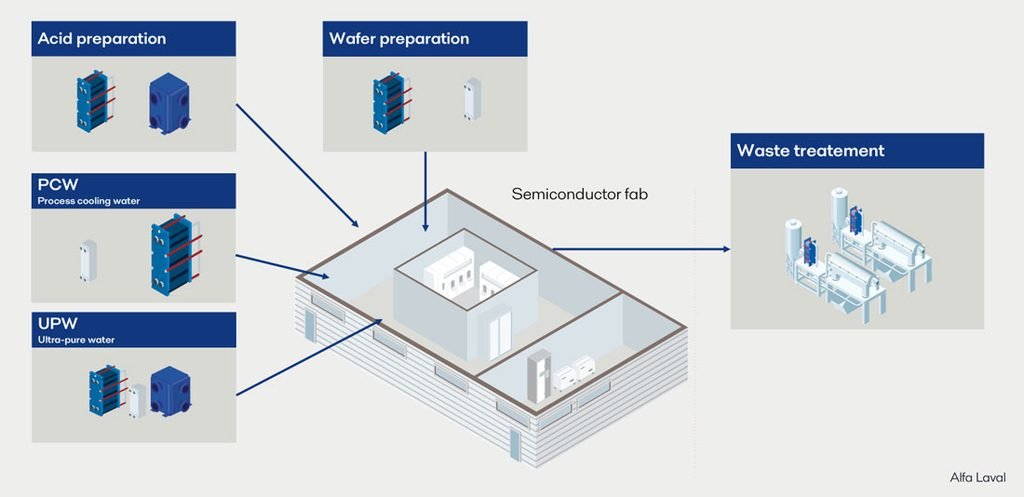
Alfa Laval draws on decades of industrial efficiency experience to help fabs recover waste heat, switch from mechanical chillers to free ambient cooling for part of the year, and cut both energy and water use without redesigning the plant around it.
How is global demand shifting, and where does Europe fit in?
Demand sits overwhelmingly where the semiconductors are produced, and that is outside Europe, accelerating primarily in Asia and the US. For Alfa Laval, Taiwan has been a large market for 30 years, alongside South Korea and China. Demand from the US has grown strongly over the past six years on the back of the CHIPS Act and broader regionalisation. India is also seeing significant growth.
According to Kabil, the industry has stopped behaving the way it always has. “Historically this was a cyclical industry: some new technology, the electric car, solar panels, the smartphone, would drive a wave of demand, followed by oversupply and a sharp decline. What we’re in now is different. It’s a super-cycle driven by data centres and AI, moving at unprecedented speed, and so far we’re not seeing it slow down.”
Demand for semiconductor-related business in Europe looks different because it lacks that fab-building demand. What is being built, such as the Taiwan-backed ESMC plant going live in Dresden, serves automotive and industrial applications at less advanced nodes, not the sub-10-nanometre chips driving AI and data centre demand. In Europe, Alfa Laval mostly sells to the equipment manufacturers themselves, the companies building the tools that go into fabs worldwide, rather than to fabs directly. Europe’s real strength sits a step upstream of the demand, in the equipment and materials that get exported into fabs being built elsewhere. “What Europe does have as a strong offer into the global value chain is critical equipment manufacturing that enables the advanced nodes being built elsewhere. ASML is the clearest example, their EUV machines are essential, you cannot make an advanced chip without them. I would love to see more projects in Europe around advanced node manufacturing.”
Why has sustainability become a competitive edge?
For years, Alfa Laval was the one making the case for heat recovery and energy savings. “That has flipped. Now our customers are asking us to provide it, and some are investing more in heat recovery than in process cooling water itself. Return on investment is still a big part of the equation, but the importance of saving water and energy carries real weight of its own, and heat recovery has become an industry standard.”
A widely cited Greenpeace estimate put the industry’s emissions on track to grow 138 percent on a business-as-usual path, well beyond what major manufacturers have committed to and further still from what the Paris Agreement’s 1.5-degree pathway would require. “Water tells a similar story. An average fab can use up to 10 million gallons a day, comparable to around 33,000 US households, and new fabs keep landing in water-stressed areas across the US, India, and East Asia.” Kabil points to the commercial case as well as the environmental one: most equipment pays for itself within a very short operating cycle.
Why isn’t Sweden’s and Europe’s contributions as suppliers better recognised?
Benjamin Kabil sees the answer less in any single company and more in the ecosystem around it. ASML is the exception, fully focused on the semiconductor industry and a well recognized brand in that sphere. Alfa Laval’s challenge is different, and one it shares with other traditional utility and compressor manufacturers. “People think of Alfa Laval as a milk separator company, and historically that’s fair since it is our origin. But our offer has developed a lot since then and today we have equipment inside almost all of the world’s chip fabs. A lot of manufacturers like us aren’t necessarily seen as semiconductor companies, even though we’re deeply present in this industry. It’s an easy thing to miss.”
Alfa Laval may not put its name on a finished chip. But from the water that cleans the silicon to the heat recovered from cooling it, its equipment runs quietly through nearly every stage of how one gets made, on a global scale.